Behavioural safety
Behaviour-based safety that shows where unsafe behaviour happens
Surveily spots unsafe behaviour on the cameras you already have, from climbing on equipment to phone use in restricted areas. Events are de-identified by default and grouped by zone and time.
Only 30 minutes.
No commitment required.
Software only.Runs on ~95% of standard IP cameras.One GPU server per site.

Category: 'Rocketship: Innovations in GenAI'
Trusted by







In short
Behaviour-based safety usually relies on observation cards, which capture a small sample of what happens on site.Surveily detects unsafe behaviour continuously on existing CCTV and de-identifies people by default, before anything is stored or displayed. The output is a pattern by zone and time. No worker is identified, scored or automatically sanctioned.
The problem
Observation cards cover only a small part of the day
Cameras check every area they cover on every shift, and link each event to a place, not a person.
Behaviour-based safety starts from a sound idea: serious injuries sit on top of a large base of at-risk behaviours. The weak point is the method. Observation cards cover a small part of the day, and colleagues fill them in about colleagues.
Continuous, de-identified detection changes both. The sample becomes every covered camera view, and the record is about a zone, not a person. At Reckitt Benckiser, a consumer-goods plant in Poland running 30 cameras, near-miss reports rose 800%. The site did not get more dangerous. The hidden risks finally became visible.
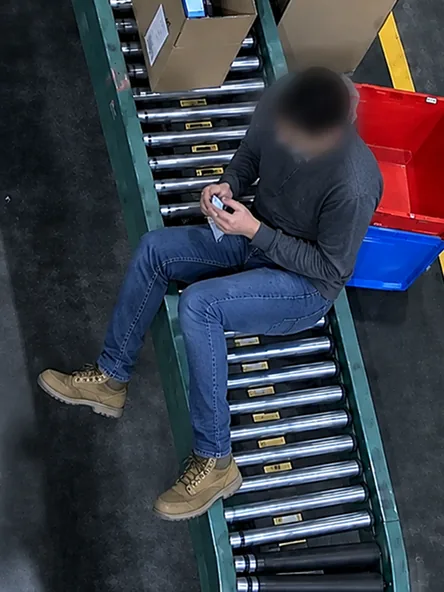
Detection modules
Nine unsafe behaviours Surveily detects, grouped by zone
Climbing
A person climbs racking, structures or equipment.
Mobile phone use
A person uses a phone in a restricted or hazardous area.
Handrail use
A person uses stairs without holding the handrail.
Incorrect crossing
A pedestrian crosses outside the designated walkway.
Crossing on red
A pedestrian crosses against a red signal.
Wrong direction
A person walks against the designated pedestrian flow.
Pallet jack as a scooter
A person rides a pallet jack instead of walking it.
Grouping
People cluster unsafely in a risk zone.
Hands in restricted areas
A person puts their hands into a restricted area.
Need a behaviour that is not on this list? We assess it on your own footage before anything is configured.
Privacy and security
You choose how much of each person stays visible in the footage
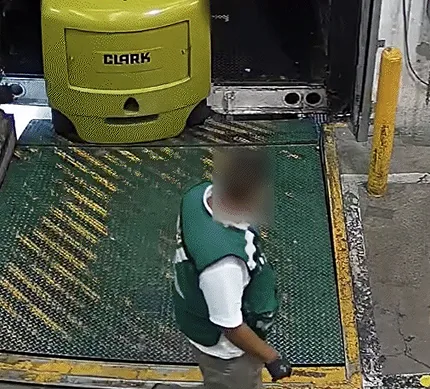
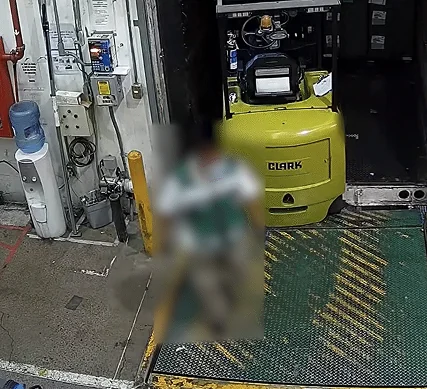
The de-identification level is agreed with your employee representatives. It is applied by default, before anything is stored or displayed.
Face blur
Faces blurred in every stored still and clip. Posture stays visible for coaching.
Head blur
The whole head is blurred. Body posture stays visible for coaching.
Full-body blur
The whole person is blurred. The standard choice for works-council agreements.
Talk to us before you brief your works council.
Only 30 minutes. No commitment required.
What our customers say
European sites in heavy industry, chemicals and building materials, all running Surveily on the cameras they already had. No new hardware went in.
Surveily AI solutions have significantly supported our safety efforts - particularly in preventing near-miss incidents involving forklifts, maintaining order on vehicle routes and pedestrian pathways, and eliminating the use of mobile phones in restricted areas. The system provides us with real-time insight into on-site activities and enables quick response to potential hazards. It’s a tangible improvement in both operational visibility and our safety culture, which we highly value.

Employee safety is our top priority - especially in the demanding environment of chemical manufacturing. Implementing Surveily’s systems significantly enhanced our oversight in critical areas. Their cutting-edge technology enables faster threat detection and real-time data analysis, resulting in a measurable improvement in workplace safety. We value Surveily’s professionalism and are proud to partner with them in building a work environment that meets the highest industry standards.

We gained significantly better visibility and control over our expansive industrial site. Their innovative monitoring technology allowed us to effectively track vehicle movement and reduce hazardous driver behavior - particularly regarding the use of personal protective equipment and adherence to speed limits. As a result, we’ve enhanced safety for everyone working on-site. We firmly believe that partnering with Surveily is an investment that delivers tangible safety benefits.

Questions employee representatives ask
Can this be used to discipline someone?
Surveily never takes automated action against a worker. Events are de-identified by default before anything is stored or displayed, and a person reviews every response. How the data may be used is agreed with your employee representatives before go-live.
What about shift or team comparisons?
Event volumes can be compared by site, shift and category. On a small crew, a shift view can point at a few people. Which comparisons are switched on is agreed with your employee representatives before go-live.
If people are not identified, what use is the data?
The value is in the where and when, not the who. If one stairwell has repeated handrail events on the night shift, you change the stairs, the lighting or the route.
Do you use facial recognition or emotion detection?
No, in any configuration and on any market. No facial recognition, no biometric identification, no emotion recognition, no worker scoring. This is built into the architecture.
Fix the places where unsafe behaviour keeps happening
In 30 minutes, an engineer shows you Surveily on real, de-identified footage and tells you what it would detect on your site.
Schedule a demoOnly 30 minutes. No commitment required.
You remain the Data Controller. Surveily is the Processor.
